Free business energy comparison
Comparing business energy? Let us do the comparison for you.
Find out for free if your business is paying too much. We compare your electricity, gas and water costs with today's market. Then a specialist will ring to explain what we found and whether anything is worth doing before your contract renews.
It takes two minutes, it's free, and there's no obligation.

- Unit rates
- Standing charges
- Contract terms
- Renewal date
See how your rates compare with what the market is charging now.
- Free, with no obligation
- Two minutes to request
- One call, at a time that suits you
- You never pay us a penny
Three ways businesses end up paying too much
It rarely happens in one go. More often a contract quietly rolls over, the renewal window passes while you're busy, or a charge on the bill goes unchecked for years.
The rollover
When a fixed contract ends and nothing new is agreed, your supplier can move you onto out-of-contract or deemed rates. They're usually far higher than a new fixed deal, and it's easy not to notice until the bills go up.
The missed window
Many contracts can only be renewed in a set period before they end. If that slips by, you're left with whatever price your supplier sets.
The bill nobody checks
Standing charges, the Climate Change Levy and VAT are easy to skim past. Unless someone checks them against your contract, there's no way of knowing they're right.
The simplest fix is to check your contract before the renewal window opens.
Check mine for free →How your free energy check works
It takes about two minutes on your side. We do the rest.
- Step 1
Tell us about your business
Your name, your business name and a phone number are all we need. If you have a recent bill to hand, you can add it, but you don't have to.
- Step 2
We compare your costs
We look at your rates, standing charges and contract terms, and compare them with what the market is charging now.
- Step 3
A specialist calls you
They'll ring at a time that suits you and talk you through what we found. There's no pressure and nothing to sign.
The check is free and you never pay us.
We introduce businesses to Assured Energy, our energy procurement partner, and they pay our fee if you decide to switch. If your current deal is already a good one, they'll tell you, and you'll know where you stand.
What your free check tells you
Four things worth knowing about your energy contract. Your specialist goes through each one with you.
When your contract ends
You'll see your end date and when your renewal window opens, so you can act before it closes.
How your rates compare
Your unit rates, set against current market prices.
What your standing charges cost
The fixed daily amount you pay whether you use energy or not.
Whether your VAT and levies are right
Some businesses qualify for a lower rate and don't know it.
Read more about each supply: Business electricity Business gas Business water
Every business uses energy differently
Your specialist looks at your rates with the way your business runs in mind.

Care homes
Heating, hot water, laundry and kitchens that run day and night, all year round.

Manufacturing
Machinery, ovens and compressors, where every penny on the unit rate adds up.
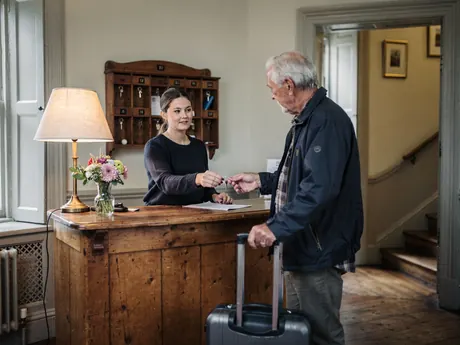
Hotels and accommodation
Rooms, kitchens and laundry, with demand that rises and falls with the seasons.

Breweries and distilleries
Heating, cooling and cleaning for every batch, often over long production runs.
Questions business owners ask us
What people usually want to know before they get in touch.
Something else? Email hello@energybench.co.uk
Is it really free?
Yes. The check costs you nothing, and you never pay Energybench anything directly. If you switch through Assured Energy, it pays our fee. Any commission Assured Energy earns from your new supplier is included in your contract's prices and shown in its main terms, so you can see it before you agree. If you don't switch, there's nothing to pay.
Who will call me?
A specialist from Assured Energy. They'll ring within two working days and go through the results with you.
Do I have to switch?
No. Plenty of businesses are already on a fair deal, and if you are, Assured Energy will tell you. What you do next is up to you.
Do I need a bill?
No. Your name, business name and phone number are enough to start with. A recent bill just makes the check more precise.
Will switching interrupt my supply?
No. Your supply comes through the same wires and pipes, so nothing changes on site. Only the company that bills you changes.
What happens to my details?
We pass them to Assured Energy and no one else, so their specialist can call you. We never sell them, and our privacy notice explains the rest.
Get your free energy check
Tell us a little about your business and a specialist will call within two working days to go through your results.
How to compare business energy prices
Business energy works differently from energy at home. There's no price cap, so your rates depend on the contract you agree. Most businesses also pay 20% VAT, and the Climate Change Levy is charged on most business use. So a useful comparison starts from your own rates and contract, not a typical tariff.
When you compare quotes, compare like with like:
- The yearly cost, not just the unit rate. Work out what each quote costs over a year from its unit rate and standing charge, using your own yearly use. A low unit rate can hide a high standing charge.
- What's fixed. Some contracts fix everything. Others pass network and other costs through to you as they change.
- The length and the end. When the contract ends, and whether it then rolls over or moves you onto out-of-contract rates.
- The exit terms and any broker fee. The notice you'd need to give, any fee for leaving early, and the broker's fee, which suppliers must show in the contract's main terms.
Our pages on business electricity and business gas go through each step, with what UK businesses pay per kWh, and our business water page covers water.
Comparing business gas and electricity
Gas and electricity are usually separate contracts, so they can be with different suppliers and end on different dates. Compare each on its own terms, and keep both end dates in your diary.
Water is separate again. Most businesses in England and Scotland can choose their water retailer, the company that handles their bills, meter readings and customer service, while their regional water company still supplies the water. Our free check covers electricity and gas, and water too wherever you can choose your retailer, so you see the whole picture.
What you need to compare business energy quotes
To quote accurately, suppliers and brokers usually ask for:
- your current supplier and your contract end date;
- your supply numbers: the MPAN for electricity, the MPRN for gas and the supply point ID (SPID) for water;
- how much you use in a year: kWh for electricity and gas, and cubic metres for water;
- a recent meter reading;
- your business's legal name and address, and its company number if it's a limited company.
Most of this is on your latest bill. You don't need any of it to start our free check, though: your name, business name and phone number are enough.
When to compare business energy
Start a few months before your contract ends. That gives you time to compare quotes and give any notice your contract needs, so you don't end up on out-of-contract rates, which are usually more expensive than a fixed contract. If you're already on deemed or out-of-contract rates, you can usually move onto a contract at any time.
If you're a microbusiness, your supplier must tell you your renewal prices before your contract ends, and that letter is your cue to start comparing. You count as one if you have fewer than 10 employees and a turnover or balance sheet of no more than £2 million, or if you use up to 100,000 kWh of electricity or 293,000 kWh of gas a year.
Business energy comparison sites and brokers
You can go to suppliers yourself or use a broker, who deals with suppliers on your behalf. Most brokers are paid a commission by the supplier you choose, which is included in the prices you pay, while some charge a fee instead. Suppliers must show any broker fees in the main terms of every business energy contract signed since 1 October 2024.
Whichever comparison site or broker you use, ask how it's paid, how many suppliers it compares and which redress scheme it belongs to. Our guide to energy brokers covers what to check.
Energybench doesn't arrange energy contracts itself. Our free check compares your rates, standing charges and contract terms with today's market, and a specialist from Assured Energy rings to talk you through it. If you choose to switch through Assured Energy, any commission it earns from your new supplier is included in your contract's prices and shown in its main terms, and Assured Energy pays our fee from it. You never pay Energybench anything directly. As with any broker, you can ask Assured Energy how it's paid, and how much, before you agree.